Family histories publish what survived. This is the other half — every
claim this record considered and threw out, every portrait that turned out to be
somebody else, and every question still open. 22 entries, each with where it came
from and how it fell.
Nothing on this page is on the main record
22Entries
12Rejected outright
4Wrong faces
9Still open
Rejected
People who are not ancestors
Names that attach themselves to a tree because they are famous, or because the spelling matched.
Jesse Linton's relationship
Rejected
The claim
Jesse Linton, who follows Robert in the Pawtucket Band conductor list, was his brother.
Where it came from
Family understanding, and the adjacency of the two names in the conductor list.
How it was ruled out
Robert's siblings are named on his memorial as Janette, James and Hugh Jr. No Jesse. The lifetime sketch independently names the brothers in the firm as Hugh and James with Edward Jollie a fourth partner. Jesse is not among the children recorded either, though only four of nine appear there.
What is still open
He belongs to the family somewhere: a Jesse Linton is assistant treasurer of the Pawtucket Glazed Paper Company in 1917. He is not among the children recorded on the memorial either, though only four of nine appear there. Nephew or unlisted son both remain possible.
Two attached sources place him at Yarmouth, Nova Scotia during the Revolution.
Where it came from
Two of the 42 sources on his profile: Poole's Annals of Yarmouth and Barrington in the Revolutionary War (1899), and a Yarmouth genealogy of the Nehemiah Porter family.
How it was ruled out
Poole's Annals is a genuine primary compilation, but its petitioner describes himself as a native of Salem who afterwards resided at Woburn, with a wife and five children. Ours was at Ipswich: his children were born there in an unbroken line through 1774, 1776, 1778, 1780 and 1784. A different Ebenezer Porter.
Why it matters
Two of his forty-two sources belong to someone else. Source counts measure attention, not accuracy — and a high count can carry a wrong-person attachment for years without anyone noticing.
Anne Bradstreet, first poet published in North America, is a direct ancestor.
Where it came from
Her father Thomas Dudley is a direct ancestor, and the inference is the obvious one.
How it was ruled out
The descent runs through her younger sister Mercy Dudley, who married Rev. John Woodbridge. Anne Bradstreet is the sister of a direct ancestor, not an ancestor.
Captain John Knight Jr (1626–1677) of Newbury held the rank of captain.
Where it came from
The rank appears in his name on the FamilySearch tree, where he carries 116 sources.
How it was ruled out
The Newbury records give him as constable in 1654, sergeant of the military company in 1666 and its ensign in 1669 — no captaincy. None of his 116 sources is a military record; they are vital records, deeds, probate and a census. He died 7 February 1677, after the Massachusetts fighting had ended. The title looks inflated, in the same way two men both appear as "Lieut. John Porter".
Costume dates a picture. Three of these were ruled out on the wig alone, and one on the shape of a dress.
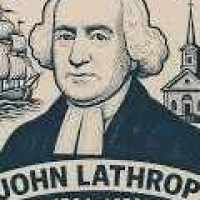
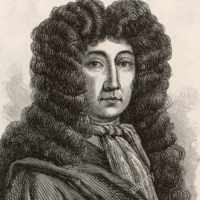
Circulated as John Lothropp, d. 1653.Circulated as Thomas Dudley, d. 1653.Attached to five of the nine passengers.
The Dudley engraving
Not him
The claim
The circulating engraving is a likeness of Thomas Dudley.
Where it came from
Genealogy sites, attached to his profile.
How it was ruled out
It shows a full-bottomed periwig, a fashion that arrived with Charles II after 1660. Dudley died in 1653.
The Lothropp badge
Not him
The claim
The circulating badge is a likeness of Rev. John Lothropp.
Where it came from
Genealogy sites, attached to his profile.
How it was ruled out
Powdered wig and preaching bands are eighteenth-century, a century after his death in 1653. A later Rev. John Lathrop (1740-1816) of Boston is the likelier subject.
The Mayflower Society emblem
Not him
The claim
Images presented as likenesses of Mayflower passengers.
Where it came from
Genealogy sites, which attach the identical file to five of the nine.
How it was ruled out
It is the General Society of Mayflower Descendants emblem, the identical file attached to five of the nine. No likeness of any of the nine survives.
A studio photograph supplied from the family album is Mary Elizabeth Gilmore Gore.
Where it came from
The family's own photographs.
How it was ruled out
Pompadour hair, lace bertha over a pouter-pigeon bodice and high gathered waist date it c.1905-1915. She died in 1893 and would have been near eighty. Her daughter Mary Elizabeth Gore (b. 30 Oct 1863) is a likelier subject.
Who it may be
There are two Mary Elizabeth Gores. She named a daughter Mary Elizabeth Gore, born 30 October 1863, who would be in her forties in that window. A granddaughter is also possible. Held back rather than captioned wrongly.
Doubtful
Legends
The Angel of Hadley
Legend
The claim
The Angel of Hadley — a phantom swordsman saved Andrew Warner's town in 1675.
Where it came from
A footnote in Governor Hutchinson's history of 1764, made famous by Ezra Stiles, President of Yale, in The History of the Three Judges.
How it was ruled out
No record of an attack on Hadley that day. The tale traces to a footnote in Governor Hutchinson's history of 1764, popularised by Ezra Stiles. The regicides Whalley and Goffe really were concealed at Hadley from winter 1664, and the secret held until Rev. John Russell died in 1692.
Sources
Ruled out by:Angel of Hadley · Wikipedia, after Hutchinson (1764) and Ezra Stiles
Unsettled
Records that disagree
Neither source is obviously the weaker. The main record carries both.
Robert Linton: Paisley 1843, or Kilmarnock 1841?
Unresolved
The claim
Born Paisley, Scotland, 1843 — or Kilmarnock, Ayrshire, 30 May 1841.
Where it came from
A biographical sketch published in his lifetime, against the FamilySearch record and its 41 sources.
The gap
The lifetime sketch says Paisley 1843; the FamilySearch record (41 sources) says Kilmarnock, Ayrshire, 30 May 1841. Different county, two years apart. Neither is obviously weaker.
Died 1961 (per obituary transcription) or 1966 (per tree).
Where it came from
An obituary transcription in the family record, against the FamilySearch tree.
The gap
The obituary is transcribed as Medford Mail Tribune, 4 October 1961, but gives her age as 92. Born 31 October 1873 she would have been 87 in 1961. Ninety-two puts it at 1966, matching the tree.
In conflict:The Gore family record · Southern Oregon Historical Society (truwe.sohs.org) · obituary transcription
Mary Gilmore and the Bible: seven, or eight?
Unresolved
The claim
Read the Bible entire before she was seven — or before she was eight.
Where it came from
Two accounts in the same family record, written by different hands.
The gap
Two accounts in the same family record, written by different hands, give different ages. Both are published.
Sources
In conflict:The Gore family record · Southern Oregon Historical Society (truwe.sohs.org)
Van Dyke: J. D. or S. D.?
Unresolved
The claim
J. D. Van Dyke (church tablet) and S. D. Van Dyke (stockade roster) are the same man.
Where it came from
The 1857 bronze dedication tablet at Jacksonville, against the 1934 measured drawing of the Gore stockade.
The gap
One initial apart between a cast bronze plaque and a handwritten roster. Almost certainly the same household — Keziah Van Dyke on the tablet was Mary Gilmore's sister — but not asserted on one letter.
Longstanding and specific, and still without the document that would settle them.
Robert Linton
Single source
The claim
Conducted the Pawtucket Band, incorporated 1880; a second Linton, Jesse, followed him.
Where it came from
A history of the band, supplied to this project.
What is missing
A history of the band lists the conductors in order. Not independently corroborated: the 1917 Slater Trust volume contains no mention of a band, orchestra or cornet band anywhere in it, and reachable Rhode Island brass-band histories do not cover Pawtucket.
Where to look
The Pawtucket Public Library's digitised newspapers, 1825–1960. A town band changing conductors gets reported.
The family record and the Ohio Company material. He reached Marietta in July 1788 and died at Little Hocking at ninety-four.
What is missing
All 42 sources on his record were read. Roughly twenty vital records (mostly his own children's baptisms), nine Essex County deeds, his father's probate, an Ohio deed index, a marriage, a Find a Grave entry and two legacy stubs. Not one is a military record.
What the reading did establish
He was in Ipswich for the whole war. His children were born there in an unbroken line — 1774, 1776, 1778, 1780, 1784 — so he was resident, of military age, in the county that mobilised hardest in Massachusetts. Essex County militia returns are where it would be, if it is anywhere.
Descends from the Sutton barons of Dudley Castle, and thence from royalty.
Where it came from
The tree runs his paternal line Roger → Henry → Sir John Sutton, 3rd Lord Dudley.
What is missing
Robert Charles Anderson holds that his paternal ancestry cannot be proven past his father Roger Dudley; Douglas Richardson does not support the claimed parentage. The Sutton connection rests largely on similarity of arms. The maternal route, via Susanna Thorne and the Purefoys, is the one scholars accept — and is untraced here.
Sources
Ruled out by:Thomas Dudley — ancestry · Robert Charles Anderson; Douglas Richardson · paternal line
His presence in the mirrored tree at generation 25, and a long-standing family belief.
What is missing
Present in the mirror at generation 25 with 0 sources, but not reachable from the anchor by any recorded edge. The traversal reaches 4,951 couples and 7,896 people at maximum depth 18; 6,907 of 12,915 couples have no parent edge recorded and 7,943 are marked terminal. Untraced, not disproven.
Sources
Context:Local edge-graph traversal of the mirrored tree · this project · 2026 · BFS from anchor couple
William Campbell in the Philippines
Unproven
The claim
Served in the U.S. Army in the Second World War, in the Philippines.
Where it came from
The family record.
What is missing
No service document produced. The 1973 National Personnel Records Center fire destroyed roughly 80% of Army personnel files for men discharged 1912-1960. Circumstantially, he took the Cornell post in 1947, the first year the universities were filling again.
What would settle it
A discharge certificate (WD AGO 53-55 or DD-214), an enlistment record, a unit photograph, a medal or ribbon bar, a burial flag, or a headstone giving branch and unit. Next of kin can also request a reconstruction from the NPRC, which rebuilds burned-block service from pay vouchers and morning reports.
John Foxe, the martyrologist
Unproven
The claim
The John Foxe in the tree is the martyrologist, author of the Book of Martyrs.
Where it came from
The FamilySearch collaborative tree.
What is missing
Born July 1516 at Boston, Lincolnshire and died 18 April 1587 in London — an exact four-point match to the real John Foxe. That is also exactly what a wishful attachment looks like at generation fifteen. Not published; the intervening generations would need proving.